Israeli policy has aimed since 1967 to politically unite the city of Jerusalem and consolidate in it a Jewish majority, while maintaining in practice an economic disparity between the Arab...
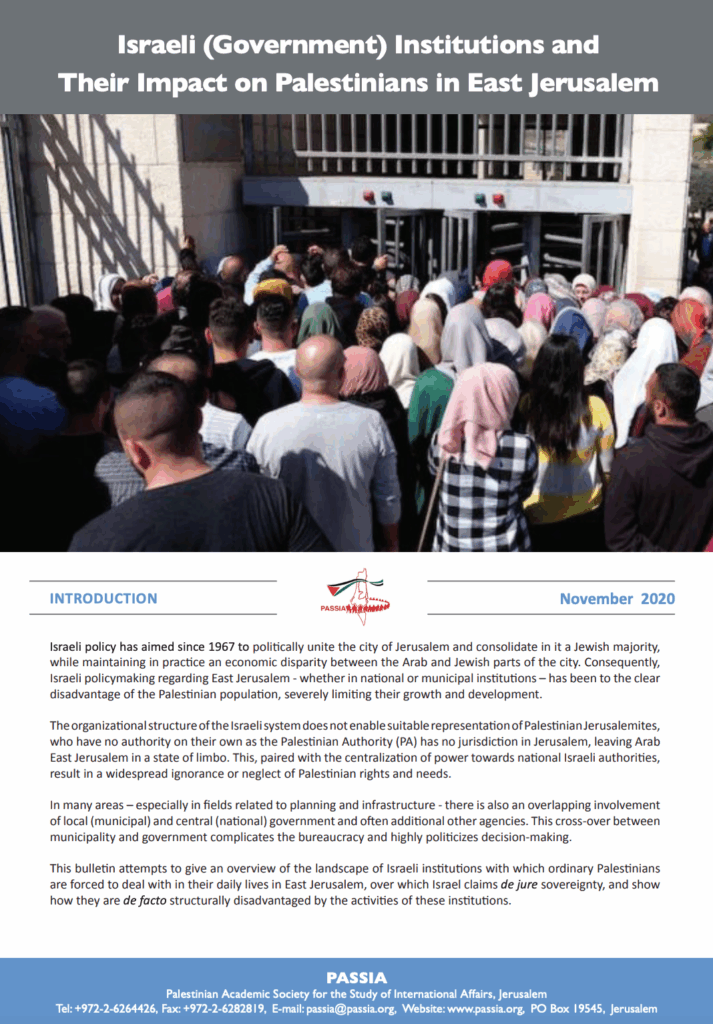
Israeli policy has aimed since 1967 to politically unite the city of Jerusalem and consolidate in it a Jewish majority, while maintaining in practice an economic disparity between the Arab and Jewish parts of the city. Consequently, Israeli policymaking regarding East Jerusalem - whether in national or municipal institutions – has been to the clear disadvantage of the Palestinian population, severely limiting their growth and development. The organizational structure of the Israeli system does not enable suitable representation of Palestinian Jerusalemites, as the Palestinian Authority has no jurisdiction in Jerusalem, leaving Arab East Jerusalem in a state of limbo. This, paired with the centralization of power towards national Israeli authorities, result in a widespread ignorance or neglect of Palestinian rights and needs. In many areas – especially in fields related to planning and infrastructure - there is also an overlapping involvement of local (municipal) and central (national) government and often additional other agencies. This cross-over between municipality and government complicates the bureaucracy and highly politicizes decision-making. This bulletin attempts to give an overview of the landscape of Israeli institutions with which ordinary Palestinians are forced to deal with in their daily lives in East Jerusalem, over which Israel claims de jure sovereignty, and show how they are de facto structurally disadvantaged by the activities of these institutions.