The Oslo Accords emerged hardly two years after the International Conference on Water and the Environment took place in Dublin in 1992. The Oslo Accords created the Palestinian Authority and...
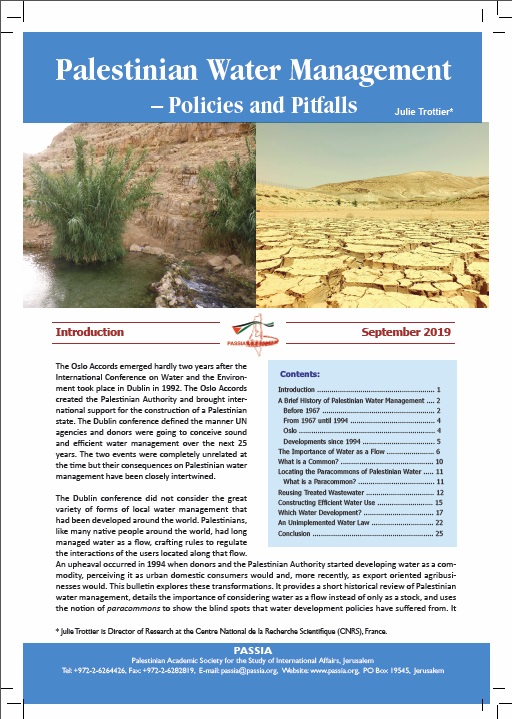
The Oslo Accords emerged hardly two years after the International Conference on Water and the Environment took place in Dublin in 1992. The Oslo Accords created the Palestinian Authority and brought international support for the construction of a Palestinian state. The Dublin conference defined the manner UN agencies and donors were going to conceive sound and efficient water management over the next 25 years. The two events were completely unrelated at the time but their consequences on Palestinian water management have been closely intertwined. The Dublin conference did not consider the great variety of forms of local water management that had been developed around the world. Palestinians, like many naïve people around the world, had long managed water as a flow, creating rules to regulate the interactions of the users located along that flow. An upheaval occurred in 1994 when donors and the Palestinian Authority started developing water as a commodity, perceiving it as urban domestic consumers would and, more recently, as export oriented agribusinesses would. This bulletin explores these transformations. It provides a short historical review of Palestinian water management, details the importance of considering water as a flow instead of only as a stock, and uses the notion of paracommons to show the blind spots that water development policies have suffered from. It interrogates the notion of “efficient water use” in terms of environmental justice and shows the unintended consequences of the water development e orts over the past 25 years: Policies based on the no on of virtual water are not decreasing the consumption of water in agriculture. Present projects of wastewater reuse in irrigation are not decreasing the pressure on the aquifers. More crucially, the present water driven Palestinian agricultural frontiers are deeply transforming Palestinian society. This bulletin ends by considering possible ways forward to improve the Palestinian water situation.